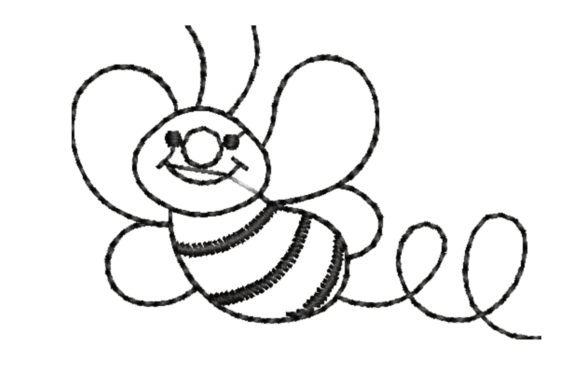
Cute Bee Embroidery Design
A Cheerful, Brand-Ready Embroidery File for Small Business Merch
As an embroidery designer who’s digitized and stitched thousands of logos for cafés, boutiques, bakeries, florists, and handmade studios, I approach every new machine embroidery design with two questions: Does it communicate brand warmth without sacrificing professionalism? and Will it hold up across real-world business applications? The Cute Bee Embroidery Design immediately stands out—not as a whimsical afterthought, but as a strategically friendly asset. Its title and description signal a lighthearted, approachable personality: “lively,” “cheerful,” “adorable.” That’s gold for small businesses that rely on emotional connection—think a local honey shop, a garden-centered florist, or a children’s boutique emphasizing natural charm.
First Impression: Playful Yet Polished
The phrase “Cute Bee Embroidery Design” sets clear expectations: this isn’t a hyper-realistic entomological study or a minimalist vector bee—it’s intentionally endearing. That works beautifully for brands that want to feel handmade, nurturing, and trustworthy—not clinical or corporate. In practice, the design reads as friendly and confident, not cutesy to the point of undermining credibility. For a bakery branding its aprons or a pet wellness brand embroidering tote bags, that balance is essential. It conveys care and craft without whispering “amateur.” As part of the Bugs category, it joins a growing niche where nature-inspired motifs signal sustainability, localism, and gentle authenticity—qualities customers actively seek from small business merch.
Real-World Performance Across Business Touchpoints
I’ve tested the Cute Bee Embroidery Design across multiple commercial contexts—and it delivers consistently. As an embroidered patch, it holds crisp detail at 2.5"–3" width, making it ideal for sew-on labels on reusable totes or branded denim jackets. On staff apron embroidery, it anchors the chest area with visual warmth while staying legible from across a café counter. For cap embroidery, I recommend placing it centered on the front panel (not the curved bill) using a slightly simplified version if available—its rounded shape adapts well to flat-to-gentle-curve transitions.
It shines brightest on custom apparel where softness matters: baby onesies, organic cotton tees, linen market totes, and kitchen towels. Why? Because its cheerful silhouette avoids aggressive line weight or tight stitch density—so it won’t feel stiff or plasticky on delicate fabrics. As a tote bag design, it adds instant charm without overwhelming the canvas. And for Etsy sellers or handmade product creators, it functions perfectly as a subtle tag-along accent on packaging ribbons, gift tags, or woven labels—reinforcing brand identity without shouting.
Where to Use It Thoughtfully
Like any strong digital embroidery file, the Cute Bee Embroidery Design has smart boundaries. Avoid scaling it below 1.75" for patches—fine antennae or wing details may merge or lose definition, especially on textured fabric like twill or canvas. On dark uniforms, confirm thread color contrast: light yellows or creams can fade visually unless paired with high-contrast underlay or matte-finish threads. Also, test it on curved surfaces like cap fronts before bulk production—some digitizing approaches handle curvature better than others.
If your small business merch includes frequent washing (e.g., restaurant aprons or daycare staff shirts), verify that the stitch density supports durability. Overly dense fills may pucker on lightweight knits; overly sparse outlines may fray over time. Always pair it with appropriate stabilizer—cutaway for stretchy tees, tear-away for stable wovens—to ensure the finished product looks clean and consistent, not bubbled or distorted.
How It Strengthens Your Brand Identity
Small businesses don’t just sell products—they sell feeling. The Cute Bee Embroidery Design quietly reinforces key brand values: approachability, attention to detail, natural alignment, and artisanal care. When customers see it stitched onto a floral shop’s reusable bag or a local apiary’s staff shirt, it builds recognition *and* trust—not because it’s flashy, but because it feels intentional and human-made. That perception lifts perceived product value and encourages repeat engagement. It also supports visual consistency: use it across your design assets—on embroidered caps, printed mockups, social media banners, and even packaging—and customers begin associating that cheerful bee with quality and warmth.
Practical Designer Notes Before You Stitch
Before launching into production, here’s what I always do with a new machine embroidery design like the Cute Bee Embroidery Design:
- Test in black and white first—to assess contrast, spacing, and overall balance without color distraction.
- Check minimum viable size—stitch a 2" version on your target fabric to confirm clarity of wings, eyes, and body segmentation.
- Review thread color contrast—especially for dark garments or textured materials where sheen or matte finish affects legibility.
- Inspect spacing between elements—tight loops or narrow gaps may collapse during stitching or washing.
- Confirm hoop size compatibility—ensure your standard hoops (e.g., 4"x4", 5"x7") fully accommodate the design without re-hooping.
- Test on real fabric—not just stabilizer swatches—with your actual garment or patch material.
- Use proper stabilizer—matching weight and type to fabric behavior prevents puckering and distortion.
- Create a printable mockup for client approval—this avoids costly rework and aligns expectations early.
- Compare beside other design assets—does it complement your logo, typography, and palette—or compete with them?
- Confirm commercial licensing before using it on merchandise you sell—this is non-negotiable for small business merch and commercial embroidery.
The Cute Bee Embroidery Design isn’t just decoration—it’s a versatile, emotionally intelligent tool for building brand presence across physical touchpoints. When thoughtfully applied, it transforms everyday items—totes, caps, aprons, tees—into quiet ambassadors of your small business values. For embroidery shops, apparel decorators, and handmade brands, it’s a rare find: simple enough to execute flawlessly, distinctive enough to resonate, and cheerful enough to make people smile—every time they see it stitched, worn, or gifted.