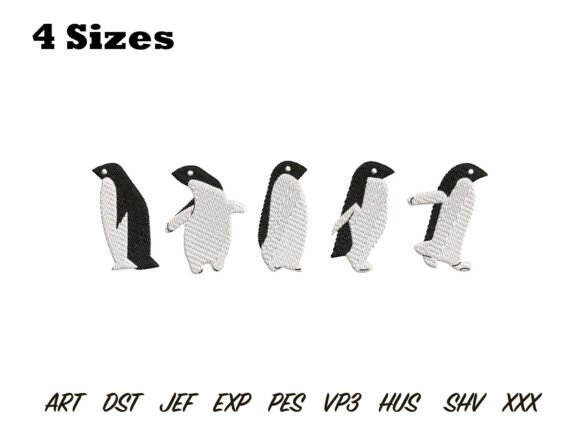
Cute Walking Penguins Embroidery
A Playful Yet Professional Touch for Small Business Branding
As an embroidery designer who’s developed hundreds of commercial designs for cafés, boutiques, bakeries, pet brands, and handmade studios, my first impression of Cute Walking Penguins Embroidery is immediate and positive: it reads as friendly, approachable, and intentionally whimsical—without sacrificing polish. The title alone signals warmth and charm, and the description confirms its versatility across t-shirts, towels, and home decor. For small business merch, that balance is gold: customers respond to personality, but they also expect professionalism. This design delivers both—not as a cartoonish afterthought, but as a cohesive, stitch-ready machine embroidery design built for real-world application.
Where It Shines in Real Business Use
Cute Walking Penguins Embroidery excels where small businesses need memorable, scalable branding: on embroidered patches for staff uniforms, chest accents for aprons and work shirts, front-cap embroidery for café teams, and subtle sleeve details on boutique totes or reusable bags. Its walking pose gives gentle motion and narrative—ideal for a florist’s “growing with joy” theme, a pet brand’s “waddle-worthy care,” or a bakery’s “sweetly steady hustle.” As a tote bag design, it adds character without overwhelming; as an apron embroidery, it softens utility with charm. On product packaging accents—think stitched tags on handmade soap bundles or gift boxes—it elevates perceived value while reinforcing a handmade product ethos. Etsy sellers especially benefit: this design translates beautifully into printable mockups for listings, helping buyers visualize how their brand will look before purchase.
Why It Works Across Fabric Types and Applications
- Embroidered patch compatibility: The clean silhouette and moderate detail hold up well when heat-sealed or sewn onto denim, canvas, or twill—common bases for retail patches.
- Cap embroidery resilience: Its horizontal orientation and balanced proportions avoid distortion on curved cap fronts, especially when digitized with appropriate underlay and pull compensation.
- Tote bag design flexibility: Scales gracefully from 3” to 5”, maintaining legibility and visual impact whether placed center-front or near the hem.
- Uniform consistency: Works equally well on light and medium-weight fabrics—ideal for matching staff aprons, chef coats, or boutique smocks without requiring multiple file versions.
Smart Placement & Design Limitations to Respect
While Cute Walking Penguins Embroidery is highly adaptable, thoughtful execution is essential. Avoid using it below 2.5” on embroidered patches—fine beak or foot details may blur or stitch poorly at tiny sizes. Cap fronts with tight curvature demand careful hooping and stabilizer selection; test on scrap fabric first. On dark uniforms or textured fabric (like heavy linen or looped terry), verify thread color contrast—light pastel threads may disappear, while high-contrast options (navy, charcoal, or crisp white) reinforce clarity and brand identity. Also note: though described as playful, it isn’t overly dense—so it performs reliably through frequent washing on work shirts or café towels, unlike ultra-high-stitch-density Wild Animals designs that risk fraying over time.
How It Strengthens Your Brand Identity
In small business merch, every stitch communicates intention. Cute Walking Penguins Embroidery subtly tells customers: “We’re joyful, human-centered, and proud of our craft.” That builds trust faster than generic logos—especially in handmade, local, or service-based niches. When repeated across staff aprons, customer tote bags, and event merch, it creates visual consistency that boosts recognition. Unlike clip-art motifs, its cohesive shape and rhythm support a unified design language—making it easy to pair with complementary assets like custom typography or seasonal embroidery files. For Etsy sellers and crafters, it enhances buyer engagement by signaling authenticity and attention to detail, turning a simple digital embroidery file into part of a larger brand story.
Practical Designer Notes Before You Stitch
- Always test in black and white first—this reveals spacing issues, overlapping elements, and density imbalances invisible in color previews.
- Check minimum viable size: Resize your embroidery file to 2.25” and 3” to confirm clarity—especially for cap embroidery or small woven labels.
- Review thread color contrast against your target fabric—don’t assume default colors will translate well on navy canvas or oatmeal linen.
- Inspect spacing between penguin figures if stitching multiple units (e.g., on a line of boutique tea towels)—tight kerning can cause thread nesting.
- Confirm hoop size compatibility with your commercial embroidery machine—some Wild Animals designs require larger hoops, but this one’s likely optimized for standard 4x4 or 5x7 setups.
- Test on real fabric with proper stabilizer: lightweight tear-away works for t-shirts; cut-away is safer for stretchy or textured materials like apron cotton.
- Create a client-facing printable mockup before production—small business owners rely on visuals to approve designs alongside other branding elements.
- Compare it beside your existing design assets: Does it complement your logo? Match your color palette? Support your tone across social media, packaging, and merch?
- Verify commercial licensing before deploying in client work or selling branded products—this is non-negotiable for any digital embroidery file used in small business merch or custom apparel.
Bottom line: Cute Walking Penguins Embroidery isn’t just decorative—it’s a functional, brand-forward tool. When applied with intention, it transforms everyday items into touchpoints that reflect care, creativity, and connection. For embroidery shops, apparel decorators, and makers building recognizable, heartfelt brands, this machine embroidery design earns its place—not as filler, but as foundation.