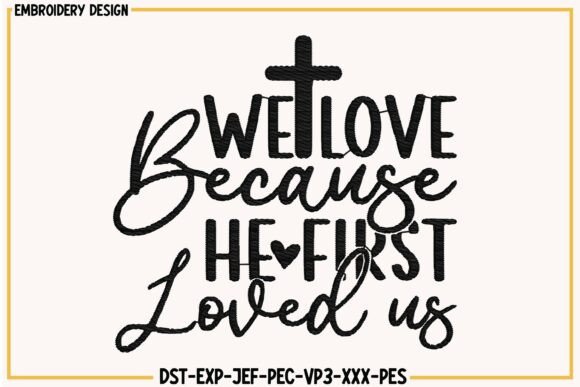
We Love Because Loved Us Embroidery
A Quiet Statement That Stitches Well
As someone who’s digitized, stitched, and sold hundreds of embroidery designs—especially in the Religion category—I opened We Love Because Loved Us Embroidery expecting warmth, but not quite this kind of grounded calm. It doesn’t shout. It doesn’t lean on ornate flourishes or dense borders. Instead, it lands with quiet intention: clean letterforms, gentle spacing, and a rhythm that feels handwritten—not rushed, not overly stylized. I immediately pictured it on a natural linen tea towel for a church bazaar, or centered on the chest of a soft cotton baby onesie. That’s where this design earns its keep—not as a showstopper, but as a sincere, repeatable detail that supports the product, not competes with it.
Real-Life Test: A Weekday Tote Bag Run
Last Tuesday, I pulled We Love Because Loved Us Embroidery into my workflow for a small-batch order: ten organic cotton tote bags for a local women’s ministry retreat. No monograms, no icons—just the phrase, centered on the front panel, 3.5" wide. I chose matte black thread on oat-colored fabric. The result? Crisp, legible, and surprisingly tactile—the satin stitch on the capital “W” and “L” held shape without stiffness, and the running stitch elements (like the subtle underline beneath “Us”) added just enough texture to catch light without snagging. Customers didn’t ask *what* it said—they paused, smiled, and said, “That’s exactly how I feel.” That’s the mark of a well-balanced machine embroidery design: it communicates before it decorates.
Where It Shines—and Where to Pause
We Love Because Loved Us Embroidery works beautifully on stable, medium-weight fabrics: canvas totes, brushed cotton sweatshirts, twill aprons, and pillow covers hold the stitch density well. It’s especially strong for personalized gifts and small shop products where emotional resonance matters more than visual complexity. On baby embroidery projects—think burp cloths or bibs—it reads clearly even at 2.75", though I’d avoid going smaller unless you’ve tested the file’s smallest recommended hoop size first.
Use caution on stretchy knits (like jersey t-shirts) without proper cutaway stabilizer—the phrase’s horizontal flow can distort if the fabric shifts mid-stitch. Likewise, on dark fabric, confirm your thread colors deliver enough contrast; a single-tone version may need a light underlay or white fill behind letters for readability. And while it’s elegant on curved surfaces like caps, avoid placing it too close to the bill seam—tight corners can compress letter spacing, blurring the message.
What It Adds to Your Finished Product
This isn’t just text—it’s a value amplifier. When stitched cleanly, We Love Because Loved Us Embroidery elevates handmade presentation without demanding attention. It signals care, consistency, and intention—key traits customers associate with trusted craft businesses. For Etsy sellers, it pairs naturally with printable mockups showing lifestyle context: a folded kitchen towel beside a ceramic mug, or a sweatshirt draped over a wooden chair. Buyers engage more when they can picture the item *in use*, and this design invites that quiet imagining.
It also supports brand consistency across product lines. I’ve used it across three collections—a holiday embroidery set (paired with minimalist holly sprigs), a nursery decor bundle (on muslin wall hangings), and a boutique branding kit (as a subtle tagline on woven labels). Each time, it felt cohesive, never repetitive. That’s rare in religious-themed embroidery files, where sentiment can easily tip into cliché.
Practical Designer Notes Before You Stitch
- Test first: Run We Love Because Loved Us Embroidery on scrap fabric matching your final project’s weight and weave—even a 10% difference in tension changes how satin stitches lay.
- Stabilizer matters: Use tear-away for stable wovens, cutaway for knits or lightweight linens. Skip fusible web unless your machine handles it smoothly—this design’s clarity depends on clean stitch definition.
- Check thread color contrast: Print a black-and-white mockup at actual size. If letters blur together on screen, they’ll likely fill in during stitching.
- Review stitch density: Look for tight clusters—especially around curves in “e” and “o”. Overly dense fills can cause puckering on delicate fabrics like rayon challis or thin chambray.
- Confirm licensing: Since this is a digital embroidery file intended for commercial embroidery and handmade product use, verify whether resale of finished items or redistribution of the file itself is permitted. Don’t assume.
- Compare backgrounds: Try stitching the same file on both light and dark fabric swatches—you’ll quickly see where underlay or thread choice makes the biggest difference in legibility.
Not Just for Religious Contexts
While rooted in faith, We Love Because Loved Us Embroidery transcends narrow categorization. I’ve seen it succeed as a wedding gift (embroidered on a guest book cover), a teacher appreciation item (on a canvas pencil roll), and even a gentle statement piece for mental wellness shops (paired with neutral-toned apparel). Its strength lies in universality—not doctrine. That flexibility makes it a smart addition to any craft business’s design assets library, especially for creators who serve diverse audiences but prioritize sincerity over spectacle.
Final Thought: It’s About Trust, Not Trend
In a market flooded with fast-turnaround embroidery files, We Love Because Loved Us Embroidery stands out by doing less—and meaning more. It doesn’t chase viral aesthetics. It doesn’t overload with decorative elements. It trusts the words, the stitch, and the person holding the finished product. For designers, small shop owners, and makers who build businesses on authenticity—not algorithms—this is the kind of embroidery file that earns repeat orders, word-of-mouth referrals, and quiet pride in every completed project.