Wildflower Book Embroidery
A Designer’s First Look: Delicate, Thoughtful, and Quietly Confident
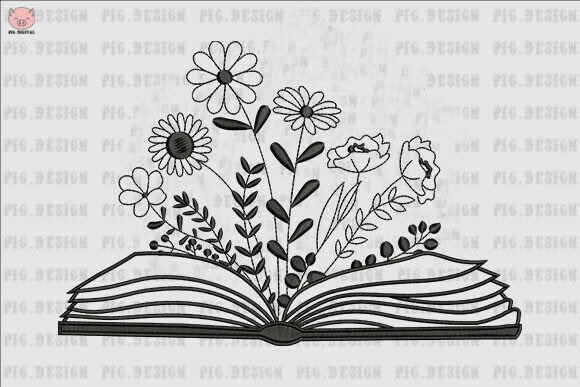
When Wildflower Book Embroidery appeared on my screen—clean, centered, with soft botanical outlines framing open negative space—I felt the immediate pull of its quiet intentionality. This isn’t a bold, high-contrast monogram or a densely packed floral explosion. It’s a curated moment: a hand-drawn book spine nestled among loose wildflowers—poppies, Queen Anne’s lace, maybe a sprig of lavender—with subtle stem lines and gentle curves. The mood is gentle but not fragile; scholarly but not stiff. It reads like something you’d stitch onto a teacher’s tote bag at the start of the school year—not as a literal “Back To School” slogan, but as a quiet nod to curiosity, growth, and the beauty in small, unforced things.
Where It Lives Best: Real Projects, Not Just Mockups
Last week, I prepped a batch of linen-cotton blend tea towels for a local boutique’s fall launch—and Wildflower Book Embroidery was my top candidate for the front corner. Why? Because it holds up beautifully at 3.5 inches wide, reads clearly without visual noise, and doesn’t overwhelm the fabric’s natural texture. I also tested it on a midweight cotton sweatshirt (charcoal heather), using a tear-away + cut-away stabilizer combo. The satin stitch petals retained their shape, the stems stayed crisp, and the open-book motif didn’t read as “clip art”—it felt handmade, intentional, and quietly elevated.
It shines on baby embroidery too: stitched in pale peach thread on ivory organic cotton onesies, the design reads as tender and timeless—not cutesy or dated. For Etsy sellers, that’s gold. Customers scroll past dozens of floral motifs daily; this one stops them because it feels *considered*, not copied. Same goes for embroidered patches—when digitized well, Wildflower Book Embroidery scales cleanly down to 2.75 inches for iron-on or sew-on applications on denim jackets or backpacks.
Where to Pause—and Test Thoroughly
Don’t assume Wildflower Book Embroidery will behave the same on every surface. On stretchy jersey (like a lightweight t-shirt), those fine stem lines can blur if stabilizer isn’t layered precisely—especially near the book’s spine where thread density tightens. And on dark fabric? That delicate outline relies heavily on thread contrast. I ran a quick black-and-white mockup first—turns out, light ecru thread loses definition against navy; switching to oatmeal gave just enough warmth and clarity.
Caps and curved surfaces are trickier. The design’s horizontal orientation and slight asymmetry mean it won’t sit evenly on a front cap panel without careful hooping and possibly minor repositioning. Also, avoid cramming it into tiny hoops (<4x4 inches) without checking how the outermost flowers render—some petals may truncate or lose stitch integrity. If you’re planning a commercial embroidery run, always stitch a full test on scrap fabric *with your exact thread, stabilizer, and machine tension settings*. What looks perfect in software rarely stitches identically across machines.
What It Adds—Beyond Aesthetics
Wildflower Book Embroidery doesn’t shout. But it builds trust. When a customer sees this on a handmade apron or personalized gift, they don’t just see stitching—they register care, attention to detail, and a designer who understands restraint. That translates directly to perceived value: buyers pay more for items that feel curated, not mass-produced. For craft businesses and small shop owners, it reinforces brand consistency—especially if you pair it with a simple serif font for tags or packaging. And yes, it performs well in printable mockups: clean lines, balanced negative space, and consistent scale make it easy to drop into lifestyle scenes without heavy editing.
Practical Notes Every Embroidery Designer Should Keep Handy
- Test first—always on scrap fabric matching your final project’s weight and stretch.
- Check thread color contrast before stitching on dark or textured fabrics; light neutrals often outperform white.
- Review stitch density—look for over-stitched areas near the book’s corners or flower centers that could cause puckering.
- Confirm hoop size compatibility—if your machine uses smaller hoops, verify the design fits without auto-resizing.
- Inspect small details—especially the book’s spine line and petal edges—under magnification if needed.
- Try black-and-white mockups to assess silhouette strength and readability at distance.
- Use proper stabilizer: medium-weight cut-away for knits, tear-away for stable wovens, and optional topping for napped fabrics like terrycloth.
- Verify licensing before selling finished products or bundling Wildflower Book Embroidery as part of a digital product—it’s essential for Etsy sellers and digital embroidery file shops.
Final Thought: Not Just Another Floral Design
Wildflower Book Embroidery stands out because it works *with* the maker—not against them. It invites thoughtful placement, rewards careful execution, and delivers a finished product that feels both personal and polished. Whether you’re stitching a custom embroidered tote bag for a teacher, adding a subtle accent to nursery decor, or building a cohesive line of boutique kitchen textiles, this machine embroidery design supports your voice instead of drowning it out. It’s not flashy—but in a sea of oversaturated embroidery files, that’s exactly what makes it reliable, memorable, and worth keeping in your active design assets.